
Before freeze-thaw season
Crack Sealing in Kansas City, MO
The cheapest way to protect asphalt is to keep water from getting under it.
- Free on-site estimates with measurements
- Itemized written quote: base, thickness, edges
- Drainage and slope checked before any asphalt is laid
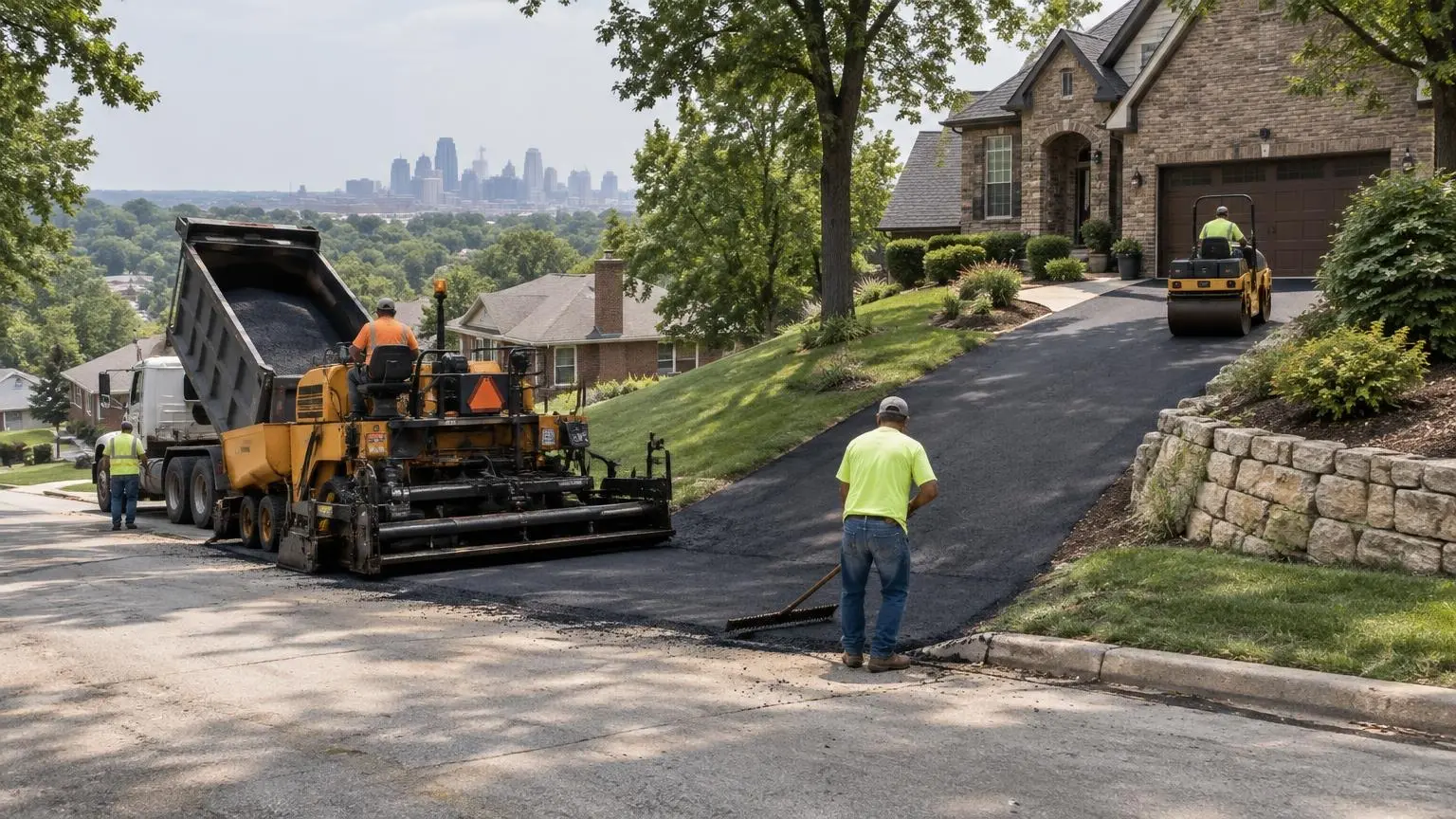
Closing the Openings Water Uses to Break Asphalt
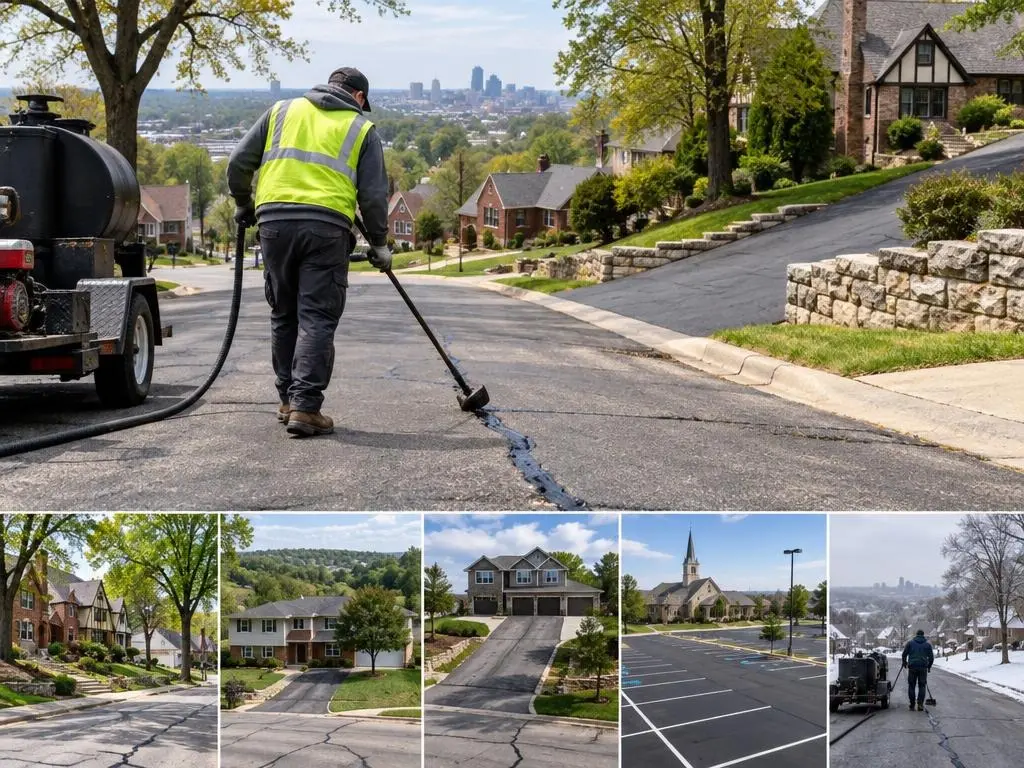
Crack sealing fills the cracks in a driveway or parking lot with a flexible sealant so water cannot run through the surface into the base. It is one of the least expensive things you can do for pavement, and in a freeze-thaw climate like Kansas City's it does a lot of work: water that gets under asphalt and freezes is what turns ordinary cracks into potholes.
What causes the cracks
SealMaster, a pavement maintenance manufacturer, lists base failure, moisture intrusion, freeze-thaw, heavy traffic and other environmental factors as typical causes. Long straight cracks often come from the pavement shrinking in the cold or from joints between paving passes. Cracks along the edges point to weak support at the side. A web of interconnected cracks, often called alligator cracking, usually means the base underneath has failed, and that needs patching rather than sealing.
Sealing versus filling
The terms get used loosely. In the trade, filling generally refers to wide cracks that barely move, while sealing refers to cracks that open and close with the seasons, which get a thorough cleaning and a hot rubberized product that stretches with them. For most driveways and lots here, we clean cracks with air or a wire brush, rout them where needed to create a clean channel, and apply hot-pour sealant, then finish it flush or with a slight band over the crack.
Timing in Kansas City
Kansas City averages freezing weather from late October to early April. Sealing in late summer or fall closes cracks before that season starts. Spring is the second-best time, once the surface is dry, to stop damage from the winter just past. Cracks are slightly wider in cool weather, which helps the sealant get deep into them.
Why it pays
SealMaster estimates crack sealing at roughly 35 cents to a dollar per foot of crack, and says each dollar put into it avoids about $6 in later costs. Even if the exact number varies, the logic holds: sealing a few hundred feet of cracks is cheap compared with rebuilding the base under a failed section.
Driveways versus lots
On a home driveway the job is often a few hours: a few long cracks, the line along the garage floor, and where the asphalt butts against the concrete approach. On a parking lot, crack sealing is usually one step in a maintenance plan, done before sealcoating and striping so the coat goes over closed cracks. Either way, the quote lists the approximate footage so you can see what you are paying for.
What This Covers
Crack sealing covers the openings before they become structural damage.
Crack cleaning
Dirt, weeds and loose material blown or brushed out of each crack.
Routing
Cracks cut into a clean channel where needed so sealant bonds.
Hot-pour rubberized sealant
Flexible sealant that moves with the pavement through temperature swings.
Joint and seam sealing
Seams where the driveway meets the garage slab, approach or a patch sealed.
Typical Crack Sealing Costs
| Item | Published range |
|---|---|
| Crack sealing, per linear ft | $0.35 to $1.00 (SealMaster) |
| Crack filling, per linear ft | $1 to $3 (Angi 2026) |
| Typical driveway crack repair | $100 to $400 |
| Minimum service charge | $100 to $250 (HomeGuide) |
Published ranges from SealMaster, Angi (2026) and HomeGuide. Small jobs are usually priced at a minimum charge rather than per foot. Kansas City prices can differ; your written estimate is the price.
How It Works
1. Walk the pavement
We map the cracks and separate those that can be sealed from areas that need patching.
2. Clean and rout
Each crack is cleaned out and routed where needed.
3. Seal
Hot rubberized sealant is applied and finished flush or banded.
4. Cool and reopen
Sealant cools quickly, and traffic returns once it is set.
Crack Sealing Questions
How much does crack sealing cost?
SealMaster's figure is about 35 cents to $1 per foot of crack; Angi shows $1 to $3 per foot for filling, or $100 to $400 for a typical driveway. Small jobs are often priced at a minimum charge.
What time of year should cracks be sealed in Kansas City?
Late summer and fall, before the freeze season starts, so water cannot get into the base over winter. Spring works too once the pavement is dry.
Can every crack be sealed?
No. Single cracks and long cracks seal well. A pattern like reptile skin points to a base that has given way, and that section has to be removed and patched.
Should I seal cracks before sealcoating?
Yes. Sealcoat is too thin to fill cracks. Cracks are sealed first, then the surface is coated.
Crack Sealing Service Areas
- Asphalt Paving in Kansas City, MO
- Asphalt Paving in Independence, MO
- Asphalt Paving in Lee's Summit, MO
- Asphalt Paving in Blue Springs, MO
- Asphalt Paving in Raytown, MO
- Asphalt Paving in Grandview, MO
- Asphalt Paving in Liberty, MO
- Asphalt Paving in Gladstone, MO
- Asphalt Paving in North Kansas City, MO
- Asphalt Paving in Parkville, MO
- Asphalt Paving in Riverside, MO
- Asphalt Paving in Belton, MO
- Asphalt Paving in Raymore, MO
- Asphalt Paving in Grain Valley, MO
- Asphalt Paving in Kearney, MO
- Asphalt Paving in Smithville, MO
- Asphalt Paving in Overland Park, KS
- Asphalt Paving in Kansas City, KS
Get a Crack Sealing Estimate
Free estimates for crack sealing on driveways and lots.