
About 319 square miles across four counties
Asphalt Paving in Kansas City, MO
Driveways, parking lots and repairs built from the subgrade up, for a city of limestone bluffs, river valleys and clay soil.
- Free on-site estimates with measurements
- Itemized written quote: base, thickness, edges
- Drainage and slope checked before any asphalt is laid
Paving a City Shaped Like a Bowl
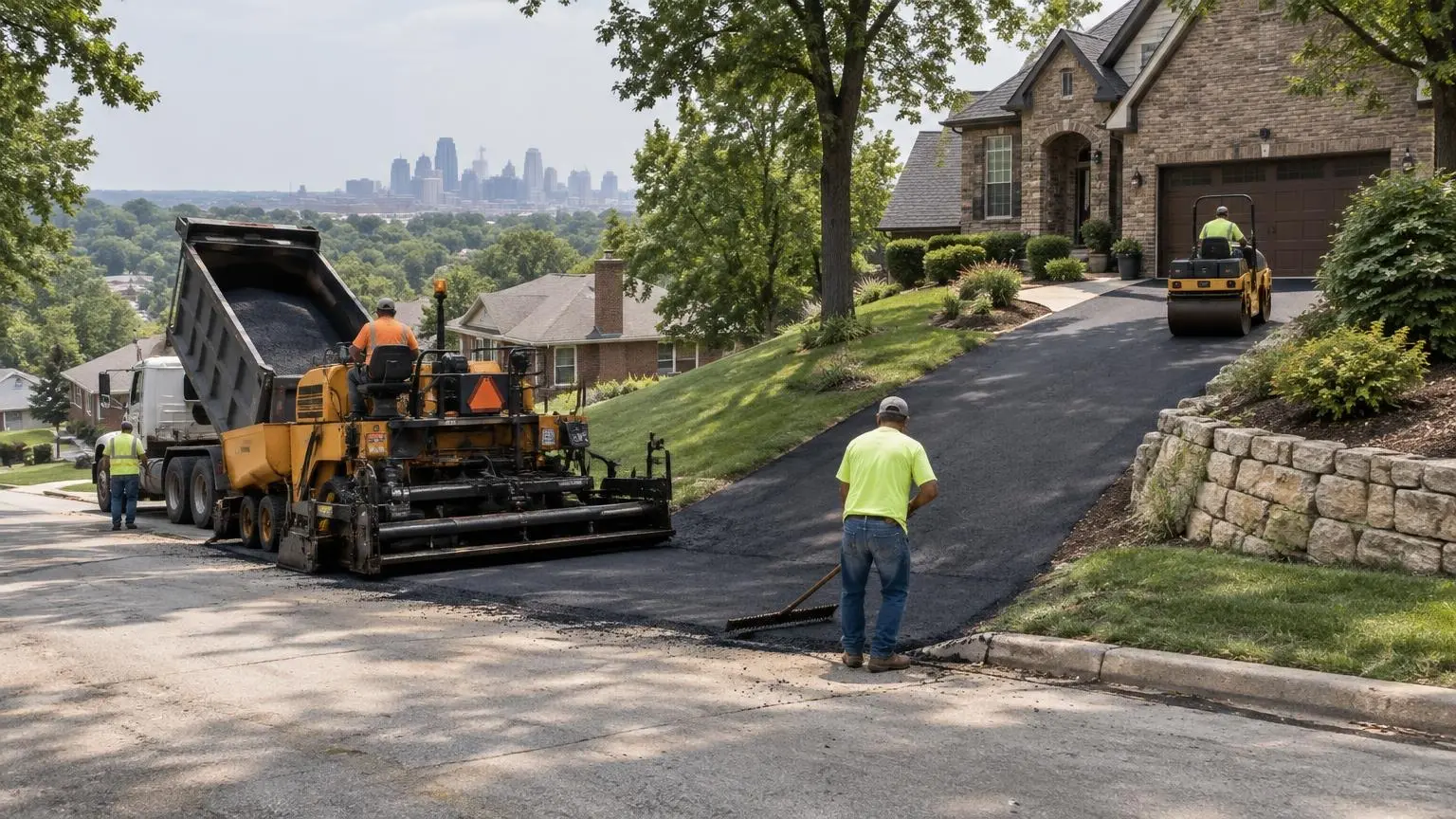
Asphalt Paving in Kansas City starts with the ground under the blacktop, not the blacktop itself. Kansas City's terrain is unusual: Wikipedia describes the central city as bowl-shaped, ringed to the north and south by glacier-carved limestone and bedrock cliffs, with bluffs dropping toward the Missouri and Kansas rivers. A driveway on a bluff-top lot in the Northland, a sloped approach off a Midtown side street and a commercial lot in the river bottoms each fail for different reasons, so each gets a different plan.
What actually breaks pavement here
Three things do most of the damage to pavement across the city:
- Water under the surface. Rain that soaks through cracks softens the base and the soil below it. Kansas City averages 38.13 inches of precipitation a year at the Downtown Airport and 39.30 inches at KCI, with the heaviest totals in late spring and summer.
- Freeze and thaw. Freezing temperatures average from October 31 to April 4, and the city logs roughly 104 air frosts a year. Water trapped in a crack expands every time it freezes, and the crack grows.
- Clay that moves. Upland loess soils of the Sharpsburg type, mapped in Missouri, Kansas and Iowa, can carry 33 to 42 percent clay in the upper subsoil. Clay swells when wet and shrinks when dry, which is why a thin layer of asphalt over a poorly prepared base tends to crack in a spiderweb pattern within a few seasons.
How we build a driveway for these conditions
We start by digging out soft or organic material instead of paving over it. A compacted aggregate base goes down next, graded so water leaves the slab instead of pooling at the garage or running toward the foundation. On steep lots we look hard at where water enters the drive from above, because a driveway at the bottom of a hill often doubles as a drainage channel. The asphalt is placed hot, rolled while it is still workable, and edged so the sides do not crumble. When an existing drive is structurally sound and only the surface is worn, an overlay can make sense; when the base has failed, we tell you that a tear-out and rebuild is the honest answer.
The KCMO driveway approach permit
Kansas City's Development Concierge explains that a vehicle use area has three parts: the drive approach, the driveway and the parking space. Only the drive approach in the public right-of-way needs a permit and inspection. The driveway and parking space on your side of the line do not need a permit, but they must still comply with Section 88-420-012 of the Zoning and Development Code. Zoning review runs through the Permits Division (5th floor of City Hall or cdpermits@kcmo.org), and the approved review then goes to Public Works at (816) 513-2670 for the approach permit. If your project touches the curb cut or the strip between sidewalk and street, we build that step into the schedule before any work begins.
Every service we offer in the city
- Asphalt driveway paving: new drives, full replacements and widening for an extra car
- Parking lot paving: new lots, resurfacing and milling for shops, churches, offices and apartment buildings
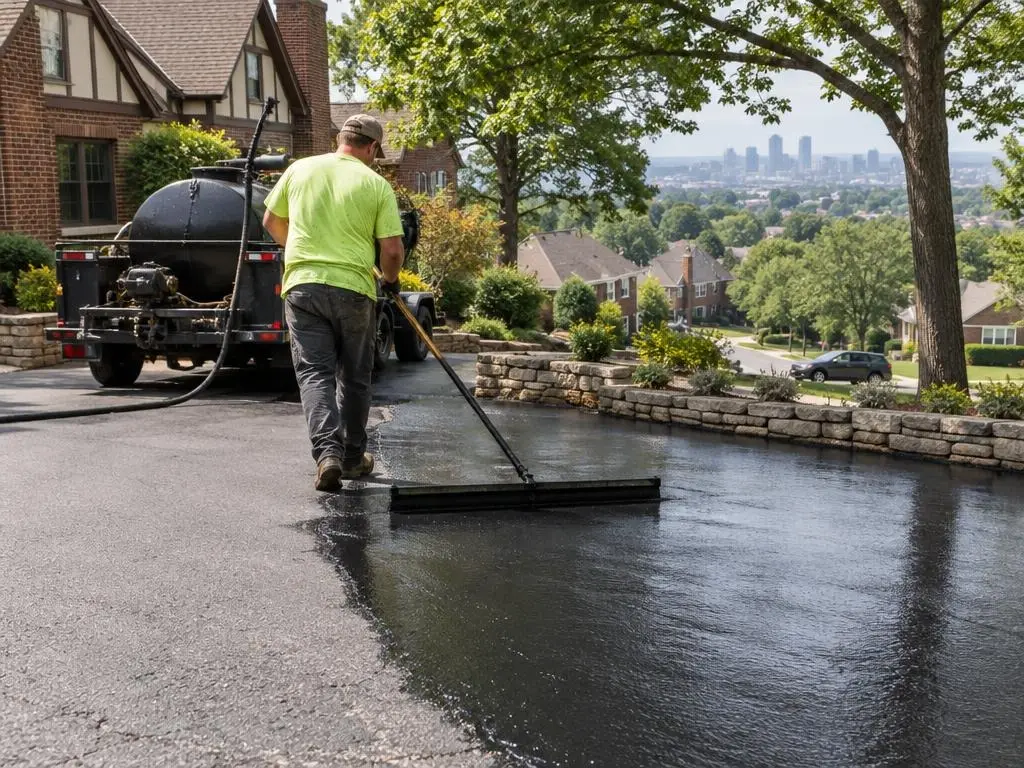
- Sealcoating: protective coats once new asphalt has cured, then on a regular maintenance cycle
- Asphalt repair and patching: potholes, sunken areas, utility cuts and failed sections
- Crack sealing: hot-applied sealant that keeps water out before winter
- Line striping: stall layouts, arrows, fire lanes and accessible spaces that follow the 2010 ADA Standards
Old neighborhoods, new subdivisions
Kansas City covers a lot of ground and a lot of eras. Westport was founded in 1833 and annexed in 1897. The Country Club District south of the Plaza, including Sunset Hill and Brookside, is crossed by Ward Parkway and lined with large historic homes. Landscape architect George Kessler designed much of the city's network of boulevards and parks, and Wikipedia notes Kansas City has more boulevards than any city except Paris. In older neighborhoods we often find narrow drives, mature tree roots lifting the edges and decades of patches stacked on top of each other. In newer Northland subdivisions the questions are usually about first sealcoats and keeping small cracks from spreading.
Rainwater is getting more attention
In March 2026 KCUR reported on a regional stormwater manual developed with the Mid-America Regional Council and 34 local governments. It sets a target for new developments and redevelopments to absorb 1.37 inches of rain on site without runoff, enough to handle about 90 percent of the region's rainy days. For commercial lots that are being rebuilt, that can influence grading and where water is sent. We work from your engineer's drainage plan when there is one, and we will point out drainage problems we see on smaller residential jobs.
When to schedule
Asphalt needs warm ground to compact properly, so most full paving happens from spring through fall. Crack sealing and patching ahead of the first freeze in late October save the most pavement. Call (816) 307-2608 or request a free estimate, and we will walk the site, measure, and give you a written quote that spells out base depth, asphalt thickness and drainage work.
Kansas City Ground Conditions
- A long freeze season. Freezing temperatures in Kansas City average from October 31 to April 4, the city sees about 104 air frosts a year and roughly 22 days with highs at or below 32 F. That is a lot of freeze-thaw cycles for any crack that lets water in.
- Bowl-shaped terrain. The central city is bowl-shaped and bordered north and south by glacier-carved limestone and bedrock cliffs, with bluffs above the river bottomland. Grade changes on many lots make drainage the first design question for a driveway.
- Clay-rich upland soils. The USDA Sharpsburg soil series, a loess soil found in Missouri, Kansas and Iowa, has 33 to 42 percent clay in its upper subsoil and a saturated zone at 1.2 to 1.8 meters during wet periods. Soils like this shrink and swell, so base preparation matters.
- Only the approach needs a permit. According to the KCMO Development Concierge, only the drive approach in the public right-of-way requires a permit and inspection. The driveway and parking space need no permit but must meet Zoning and Development Code Section 88-420-012.
- Mostly long-held homes. Census QuickFacts estimates 521,220 residents in 2025, a 55.4 percent owner-occupancy rate and 84.3 percent of residents living in the same house a year earlier (2020 to 2024).
- Heavy late-spring rain. Annual precipitation averages 38.13 inches at the Downtown Airport and 39.30 inches at KCI, peaking in late spring and summer, the same months most paving is done.
Our Services in Kansas City, MO
Kansas City Questions
Do I need a permit to repave my driveway in Kansas City, MO?
For the driveway itself, no. The city says only the drive approach in the public right-of-way, the section that meets the street, needs a permit and inspection. The rest of the driveway still has to meet Section 88-420-012 of the Zoning and Development Code. If we are replacing the approach or changing the curb cut, we plan for zoning review and the Public Works permit before work starts.
Why does asphalt crack so fast on my hillside lot?
Usually water. On a sloped lot, runoff from above can run under the edges of the drive and saturate a clay subgrade, and then freeze-thaw cycles from late October to early April widen every crack. We look at where the water comes from and grade or edge the new drive so it sheds water instead of soaking it up.
Can you overlay my old driveway instead of tearing it out?
Sometimes. If the existing asphalt is cracked only at the surface and the base underneath is firm, an overlay can work. If there are soft spots, alligator cracking across large areas or sections that sink when a car drives over them, the base has failed and an overlay will crack again. We check before recommending either.
How long should I wait to sealcoat new asphalt?
New asphalt needs time to cure before a sealcoat goes on, generally a few months. Most Kansas City owners plan the first sealcoat for the warm season after paving, then reseal every few years along with crack sealing before winter.
Free Estimates in Kansas City, MO
Free written estimates anywhere in Kansas City, from the Northland to south KC.
Asphalt Paving Near Kansas City
- Asphalt Paving in Independence, MO
- Asphalt Paving in Lee's Summit, MO
- Asphalt Paving in Blue Springs, MO
- Asphalt Paving in Raytown, MO
- Asphalt Paving in Grandview, MO
- Asphalt Paving in Liberty, MO
- Asphalt Paving in Gladstone, MO
- Asphalt Paving in North Kansas City, MO
- Asphalt Paving in Parkville, MO
- Asphalt Paving in Riverside, MO
- Asphalt Paving in Belton, MO
- Asphalt Paving in Raymore, MO
- Asphalt Paving in Grain Valley, MO
- Asphalt Paving in Kearney, MO
- Asphalt Paving in Smithville, MO
- Asphalt Paving in Overland Park, KS
- Asphalt Paving in Kansas City, KS